Apple (AAPL): The Tariff Bill Lands Offshore
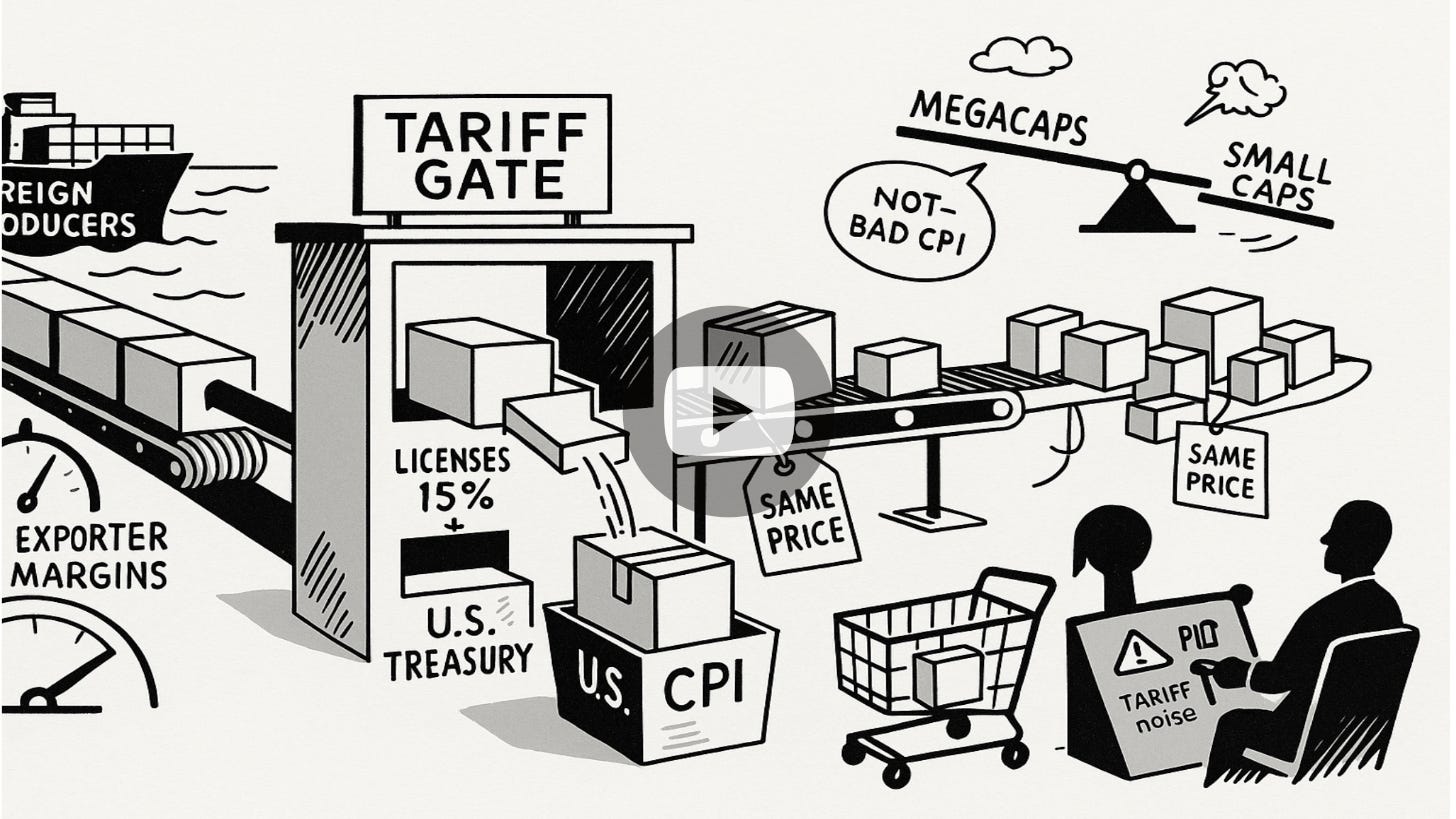
Why tariffs are working as a transfer instead of an inflation engine, what that does to the rate-cut path, and where Apple fits the rotation.
Border Tolls Skip the Grocery Cart
The forecast was easy to make: slap tariffs on imports and inflation follows. Foreign producers would rather give up margin than give up their place on American shelves, so the price increase stalls at the border. Services inflation is cooling because hiring is cooling. And if core inflation prints 0.3% for a month, I read it as noise on top of a decelerating economy rather than the opening of a new regime. Deceleration is the part the Fed actually cares about.
Meanwhile Washington has worked out how to monetize the border. Tariff receipts flow to the Treasury. Export licenses, including the ones letting chipmakers keep selling into China, now arrive with a slice of revenue owed to the government. That is policy run as a platform: the company keeps its access, the state clips the ticket, and the cost lands in a margin, a currency or a capex budget somewhere offshore. Japanese carmakers are the live exhibit, swallowing an enormous profit hit while nudging U.S. sticker prices upward only cautiously because demand is fragile. Their earnings erode long before any American price index takes the blame. Foreign margins are paying for domestic easing, and nobody has to approve of the arrangement to trade around it.
The Favorites Finally Exhale
Markets adore a transfer right up to the moment it threatens the names everyone owns. Index gains are being carried by the thinnest leadership in decades, while hedge funds have leaned hard into shorting small caps. Both sides of that tape are crowded. It would take only a CPI report that is merely not bad to flip it: the beaten-up small caps and the balance sheets nobody wanted rip higher, the megacap darlings get sold to fund the move, and the rate-cut story survives regardless because the labor data keeps demanding it. The pain trade here is a rotation.
For an options trader that reshapes the problem. Index volatility can stay sleepy while dispersion underneath runs riot, with single names pulling against each other instead of moving as a herd. In that setting a directional view expressed in one name with defined risk earns its keep. The same logic runs through the letter's aside on crypto: Bitcoin's realized volatility has drifted down toward what a grown-up asset looks like while ether squeezes on flow, and structured upside such as call spreads or bullish condors makes more sense than chasing outright. The principle is paying for the view you hold and capping the part you cannot know.
The Last Sugar Rush Left
Apple is where the argument cashes out. A $600B commitment to U.S. investment is exactly the sort of check that buys goodwill from an administration running the border as a toll booth, and the buyback engine keeps turning underneath it without any fanfare. Every other Big Tech name has already had its sugar rush. Apple has not, which leaves it as the one still waiting at the start line when a rotation begins pushing capital around. The letter takes an outright bullish position to see how that catch-up plays out.
The list from here is short. The next core inflation print, and more importantly how the market reacts to a hot one: if a warm number gets waved through as noise, the transfer thesis is winning. The labor data, since a softer jobs picture is what keeps the cut alive regardless of what goods prices do. Any further bespoke tolls out of Washington, because the chip license arrangement reads as a template rather than an exception. Japanese automaker pricing, as the cleanest gauge of who is absorbing the tariff. And on the AI side, hyperscaler capex and the utilities and power producers behind it, since the scarce input has turned out to be electrons, whatever the model headlines say. Rotations do not announce themselves; they show up as the names you were not watching doing the moving.
- AAPL
What came of it
I closed this trade on 29 August 2025, after 21 days, at +22% on the capital at risk.
Get the next Tuesday Target free
One options trade. Every Tuesday. Scored in public. The exit rule is on the card, and the letter is free to read.