Europe (EZU): America's Stimulus, Invoiced to Brussels
Why the US-EU tariff deal acts as stimulus for America billed to Europe, what it does to the euro and EZU, and which prints to watch next.
Berlin Pays for Trump's Stimulus
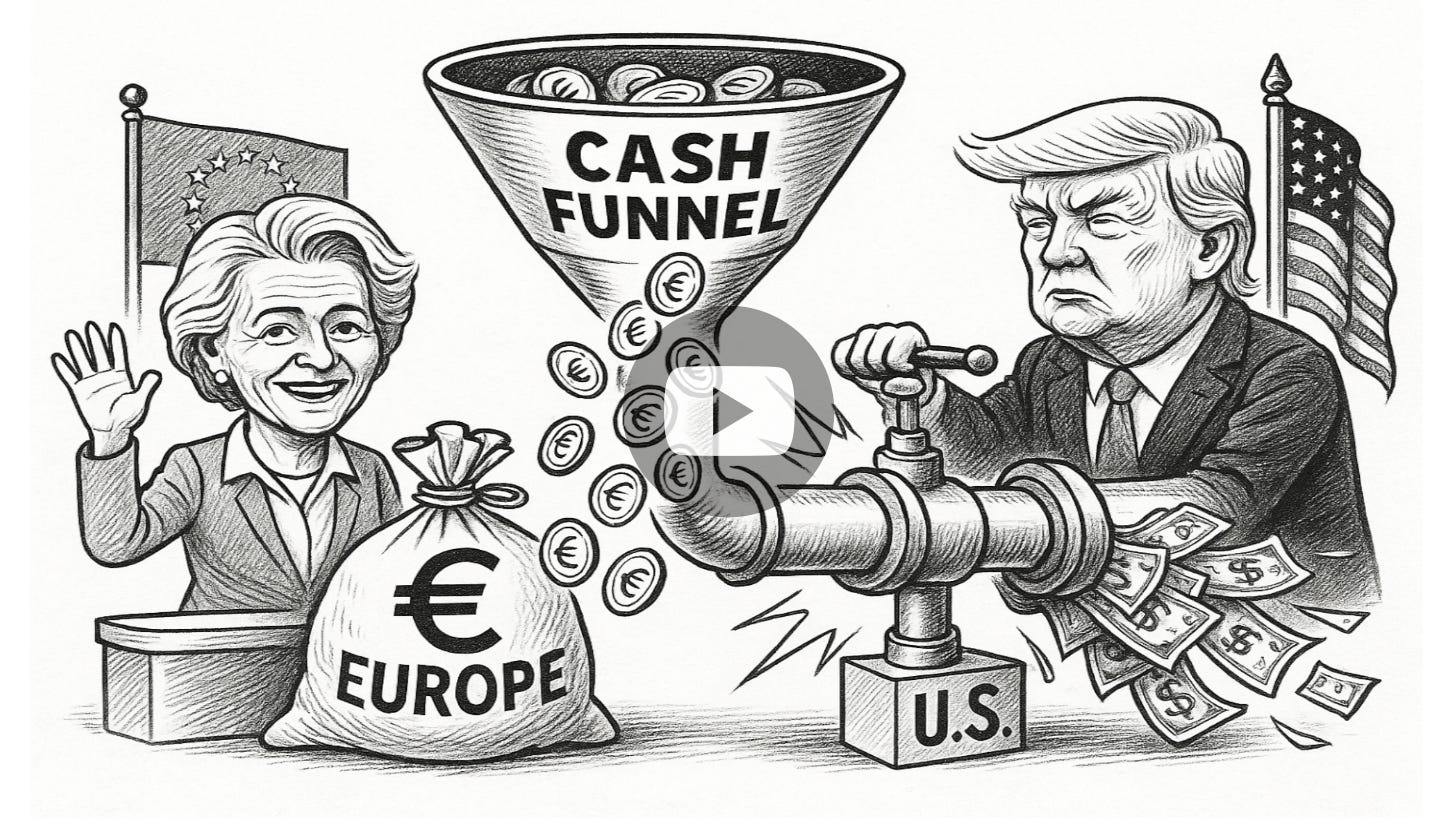
Wall Street read the American-European agreement as a ceasefire in the tariff war and priced it accordingly. The letter reads it as something closer to a pipe: money leaving Europe and arriving in the United States without the Federal Reserve lifting a finger. Europe accepts a 15 percent tariff on almost everything it ships across the Atlantic, commits to roughly $750 billion of American energy purchases and pledges another $600 billion of fresh investment on American soil. What Brussels gets in return fits inside a photograph of Ursula von der Leyen smiling next to the president.
Strip out the diplomacy and the mechanics resemble monetary easing routed around the central bank. Europe imports inflation and exports less; America imports capital, demand and a talking point. Powell can stay in his neutral corner as long as he likes, because the White House has arranged the next round of stimulus and sent the invoice to Berlin, Paris and Madrid. Partnership is the costume. The letter calls the thing underneath it a hidden liquidity pump, and the euro's slide on the announcement was the first receipt, with more to come.
The Euro Was the First Price
For anyone trading options the first consequence is currency. The first half of the year produced the weakest dollar in more than half a century, and consensus grew comfortable being short the greenback. A single tariff headline then delivered the euro's sharpest single-session drop in months. With the term premium climbing and real short rates slipping, the letter's concern is a positioning squeeze that turns short dollar into king dollar in days rather than quarters. European margins, already trimmed by the tariff, would then be marked in a currency heading the wrong way as well. That is the gravity the letter pictures SAP, HSBC and Sony trying to shift.
The second consequence is the price of insurance. Microsoft, Meta, Amazon and Apple report in the days after the letter, and option markets have priced the smallest post-earnings moves in years. The semiconductor reports that preceded them rested on the same calm assumption, and Texas Instruments answered with a double-digit drop. The letter's read is that both tails, up and down, are cheaper than the setup deserves. A bearish lean on Europe sits comfortably beside that view. The trade is into strength, which is why the letter warns against attempting it alone, and why the full structure stays on Substack rather than here.
Yields, Zero Days and the Prints
The megacap prints are the near-term test of that volatility argument. Beyond them, a pair of slower stories deserves attention. The benchmark Treasury yield is converging with nominal growth for the first time in decades, closing the era in which Washington serviced its debt almost for free. If yields climb above growth, expect the conversation to move quickly to yield-curve control, or to the spending choices Congress has spent years avoiding. Either answer matters for how long the European cash funnel can keep the machine running.
The other is the plumbing of the options market itself. Zero-day contracts on the S&P now account for more than half of index option volume, a share last seen at the top of retail speculation cycles. They dampen realised movement right up until a single-direction flow forces dealers to hedge in size, at which point the dampener becomes the accelerant. A VIX in the low teens, in the letter's phrasing, is borrowed time.
China is the outlier in all of this. MSCI China is having one of its strongest years since the start of the last decade while hedge funds and mutual funds remain underweight, and southbound flows from the mainland sit at multi-year highs. If the dollar does rebound, Asia may be the place where earnings growth and a currency hedge arrive in the same package. The near-term checklist is short: the dollar for confirmation of the squeeze, the benchmark yield against growth, and whether the megacap moves stay inside the ranges the market paid for. Europe has agreed to bankroll America's next leg higher. The interesting part starts when the invoices come due.
Get the next Tuesday Target free
One real options trade every Tuesday before the US open, entry, stop and target named. Free to read.