Micron (MU): Big Tech Passes the Hat
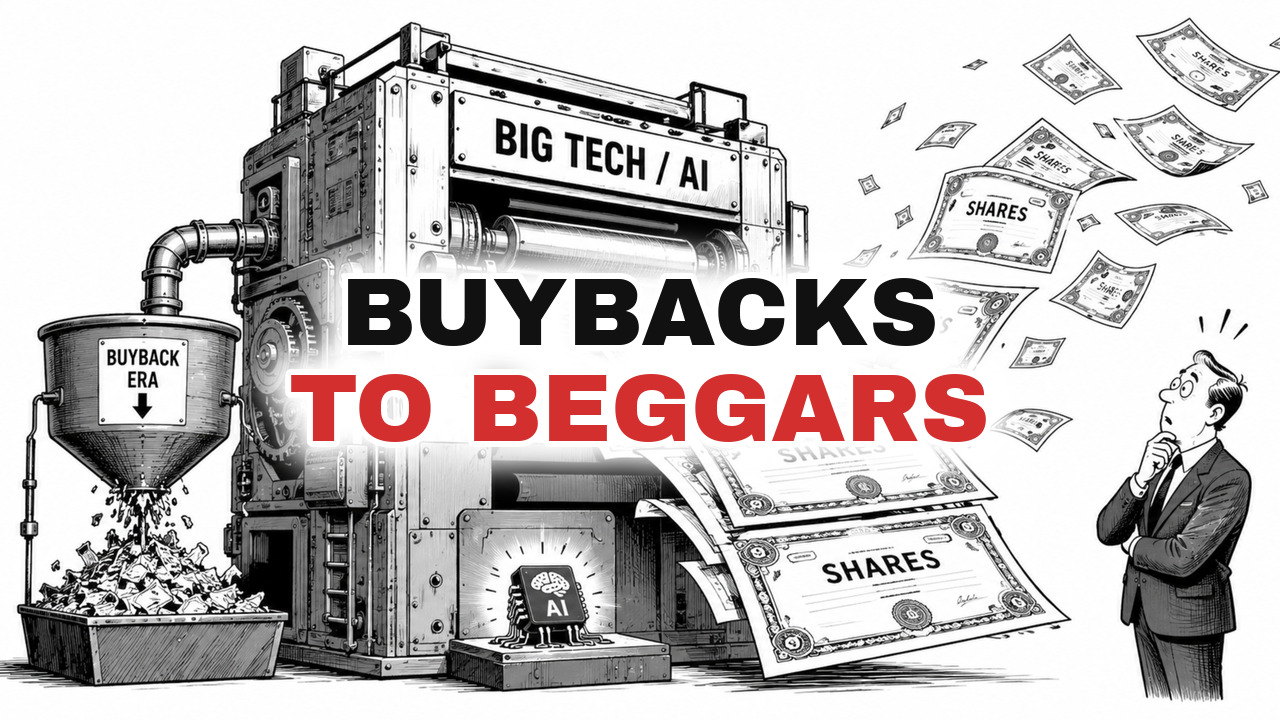
Why Big Tech's swing from buybacks to share sales changes the case for Micron (MU) options, and what memory scarcity still protects.
Fewer Slices, Then More Slices
For most of a working career, the largest technology companies did something almost boring with their cash. They retired their own shares. The float shrank, earnings per remaining share grew, and the market rewarded the arithmetic without anyone having to build anything new. A supply story dressed up as a growth story, and it worked because the direction never changed.
Now it runs backwards. Google is raising equity on a scale nobody imagined during the buyback decade. Meta keeps circling the idea of issuing stock. SpaceX, OpenAI and Anthropic are racing to list. The firms that spent years pulling shares out of circulation are gearing up to issue them the way post-war treasuries issued bonds. When the buyers of last resort turn into sellers of first resort, equity supply stops being a tailwind and becomes something the market has to absorb.
Efficiency Eats the Shortage
The consensus pitch for all this paper is that artificial intelligence needs more chips, more data centres, more power, more of everything, so the money has to come from somewhere. Fair enough. The awkward footnote is that the models themselves are shrinking, getting cheaper to run and increasingly living on the device rather than in a warehouse full of racks. If intelligence gets efficient faster than the bankers' spreadsheets assume, the compute shortage everyone is financing could turn into a glut before the last data centre is wired.
Timing is the tell. Washington can afford to let Tehran stew, because every passing month weakens Iran's position. Silicon Valley has no such luxury. Its capital has to be raised before investors start asking the rude question about whether the magic machine ships with margins attached. Urgency on the seller's side is information for anyone standing across the tape.
The Cleanest Lane Left
So where does Micron sit in a story about dilution and shrinking models? Memory. While the market throws a tantrum over AI capital spending, memory remains the stretch of the chain where scarcity is still physical rather than narrative. Chips can be optimised away and model sizes can fall, but the bits still need somewhere to live, and Micron makes the somewhere.
For an options trader that changes the shape of the position more than the direction. The letter offers itself, half joking, as a contrarian indicator and reaches for a short-dated, defined-risk structure ahead of earnings: a lottery ticket with a known worst case rather than a conviction long. The target is a quick measured move back toward the prior high, perhaps a brief overshoot into a double top, and the discipline is to cash out once price reaches the zone or momentum stalls.
Strength as the Threat
The backdrop explains why insurance is still worth its price. May payrolls printed 172k against a far smaller consensus, a surprise so large it torched the rate-cut dream and left futures leaning toward a hike by year-end. A strong labour market hands the hawks ammunition, so the best data of the spring became the trigger for the selloff. The letter's tactical read is respect for the bounce without chasing it, an expectation that Friday's low gets tested again, and a preference for the most liquid, highest-conviction longs with downside protection in place while it is cheap.
The calendar decides whether that read holds. Wednesday's May inflation print is expected above four percent, energy doing the heavy lifting, and Thursday's producer prices flow into the gauge the Fed actually watches. Around them sit a Bank of Canada hold, an ECB hike that is close to a formality, Friday's consumer sentiment, Chinese trade and inflation, plus Oracle and Adobe earnings. Then SpaceX drops the largest IPO on record onto a market still digesting hot payrolls, and the week after that Warsh chairs his first Fed meeting. Bitcoin breaking its February lows on forced selling and gold sliding on Turkish central bank sales to defend the lira both read as plumbing rather than verdicts. The thing to watch is simpler: whether memory keeps its scarcity premium while the rest of the AI trade finds out what dilution feels like.
This page is the write-up. The full letter, with the trade and its exit rule, is on Substack.
Get the next Tuesday Target free
One options trade. Every Tuesday. Scored in public. The exit rule is on the card, and the letter is free to read.