Nvidia (NVDA): Printed Dollars Against a Grid That Can't Keep Up
How price-capped power auctions and fast money growth prop up the AI capex cycle, and what that means for holding Nvidia (NVDA) through options.
Loophole Upstairs, Leak in the Basement
The cheerful version of the Nvidia story runs on a licensing agreement. Rather than buy Groq outright and invite a lengthy antitrust review, Nvidia licensed its way to the people who built Google's TPU, folding a rising inference rival into its own payroll without the regulators noticing anything worth blocking. Clever, expensive, and worth a raised glass. The letter raises one too, then walks down to the basement.
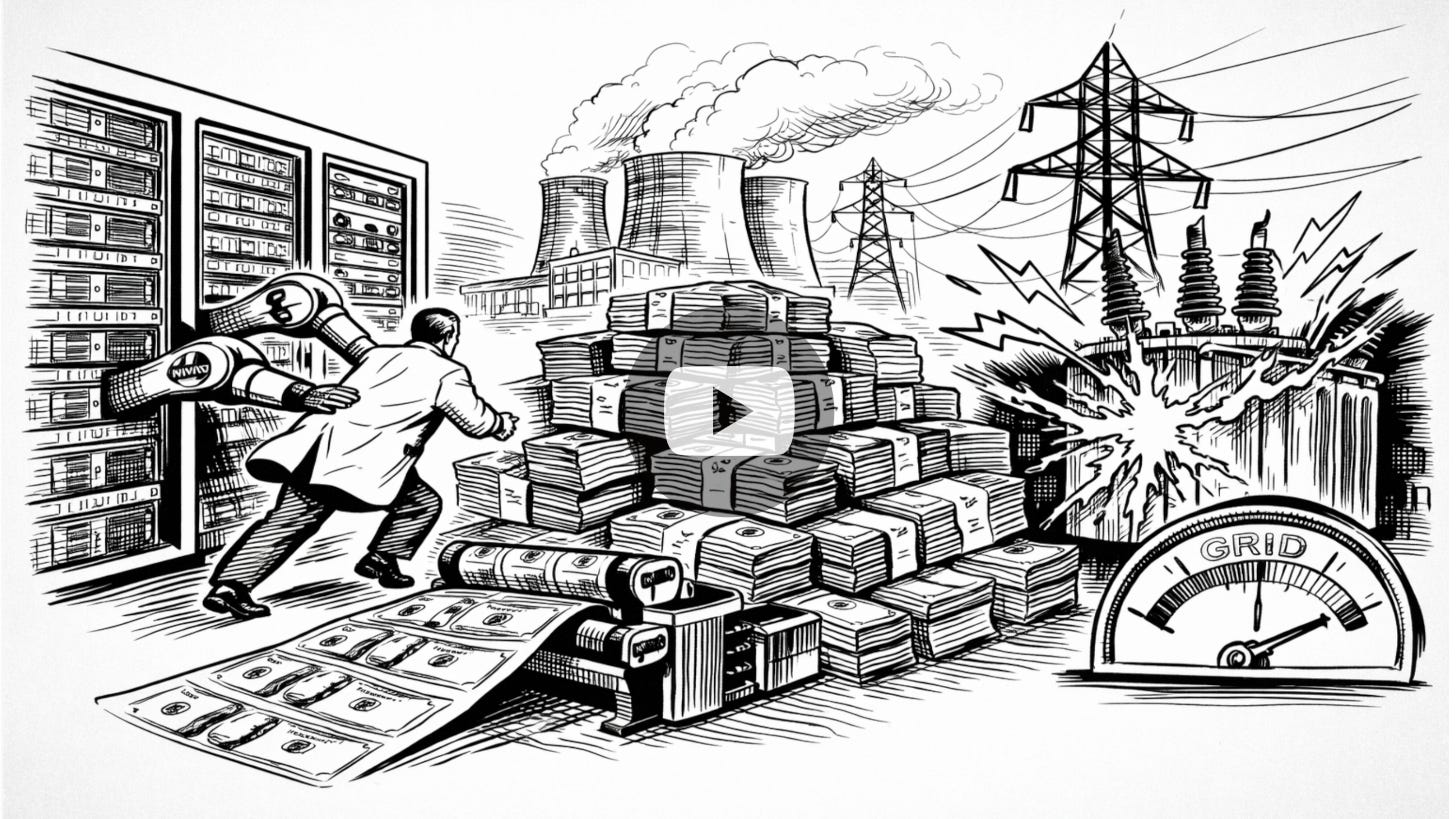
Down there sits the appendix of the latest PJM capacity auction, which admits that without regulatory price caps the electricity bill for data centers would have cleared 60% higher. Read that as a subsidy. The grid cannot physically carry what the AI build-out wants to plug into it, so the price signal gets muzzled and a shortage is dressed up as affordable power. Behind the muzzle waits a multi-trillion rewiring job: existing racks were designed for a lower-voltage world, and megawatt-density AI hardware demands an entirely new higher-voltage architecture, with the cooling, power chips and copper to match.
Who pays? The letter's answer is the printing press. Money supply is expanding at 12% to chase real growth of 3%, which means the currency gets thinned out to paper over friction the physical economy refuses to resolve on schedule. Leaking plumbing, wobbly voltage, freshly printed dollars for the repair bill. That is the macro backdrop for a chip stock most people still treat as a clean software-margin story.
Copper Busbars and Printed Dollars
For an options trader the immediate consequence is where the capex lands. The rewiring money flows past Nvidia's income statement toward the industrial suppliers of liquid cooling, advanced power semiconductors and copper busbars, the unglamorous hardware that turns a chip order into a running rack. Copper gets its own look in the letter, with pricing work planned around the FCX option chain. The theme has a picks-and-shovels layer beneath the picks-and-shovels layer.
The other consequence concerns patience, or rather the price of it. When money grows far faster than output, a claim on scarce real capacity tends to age better than the paper measuring it, and the letter notes that Nvidia sits near its relative valuation lows despite the noise. The idea floated, without an official entry, is a long-term equity replacement structure: capital at risk defined on the option chain rather than parked in the full share price, then left alone for months. The letter is blunt that this bores the impatient gambler. The physics behind the thesis moves on the timescale of rewiring a grid, so the structure has no business needing the weekly tape to cooperate.
The letter's counterexample is the air taxi trade, where hype runs well ahead of hardware. Joby burns cash at a ferocious clip against negligible revenue and trades at a multiple that assumes regulators and aviation safety will cooperate promptly. The realistic timeline stretches into decades. Same lesson as the grid, told from the other side: physics sets the schedule, and the market keeps mispricing how long physics takes.
Machines Hunting an Empty Room
The near-term calendar is thin ice. Holiday trading drains liquidity, algorithms supply most of the noise, and with the exchange shut on Thursday the surrounding sessions invite erratic prints as machines hunt for volume that is not there. Sudden moves in an empty room usually reveal a shortage of counterparties rather than a shift in the thesis.
A pair of prints count more than the rest. The FOMC minutes open the sequence with a read on how divided the committee has become over further cuts, which matters when the whole argument rests on how freely the dollars keep flowing. Chinese PMI data follows on Wednesday as a pulse check on the industrial recovery story that feeds copper demand. Silver, the letter reckons, settles into a long sideways chop after its broken squeeze. And beneath the calendar sits the question that outlasts it: how long a grid running on price caps and printed money can keep the AI narrative lit.
This page is the write-up. The full letter, with the trade and its exit rule, is on Substack.
Get the next Tuesday Target free
One options trade. Every Tuesday. Scored in public. The exit rule is on the card, and the letter is free to read.