Second Leg Down (S&P and DAX): One Debt Jar, Two Spoons
The US market's second leg down, S&P and DAX concentration, tariffs as leverage, and where widening credit spreads turn a trade war into forced selling.
Two Hands in the Debt Honeypot
The letter opens on a move I had been waiting for: the US market taking its second step lower after the first one got interrupted. Pension money kept arriving on schedule, retiree contributions that do not care about valuations, and that flow softened the slide for a while. Anyone running their own book got a window out of it, either to lighten up or to put on protection for a few weeks. That window, rather than any forecast of where the index lands, is what the issue is really about.
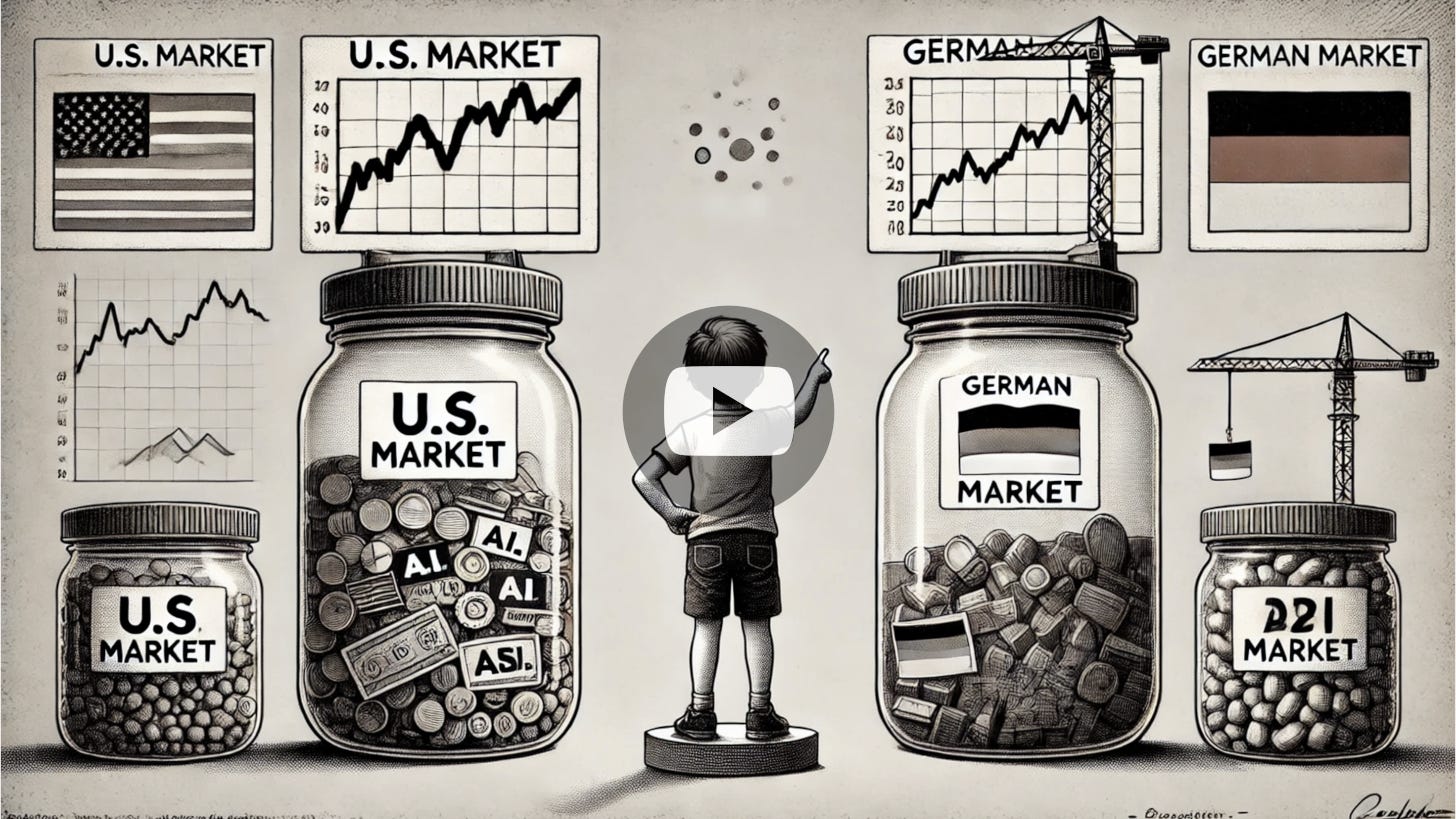
The argument is simple enough that a child with no market baggage could follow it. After Covid both Washington and Berlin had a debt honeypot in front of them. The Americans reached in deep, and their biggest handful of companies, now roughly 30% of the S&P, rode the AI story and the election tailwind on borrowed fuel. Germany hesitated, and only now are its largest names, about 40% of the DAX, dipping their own hands in to rearm and rebuild. Two indices, two spoons, one jar, and a lag between them that explains most of the divergence people keep mistaking for economic insight.
None of it maps onto the real economy. The Mittelstand is squeezed and the MDAX has gone sideways for as long as anyone cares to remember. In the US the rot runs deeper each year, homelessness, drug epidemics, obesity, all polished over by AI-fuelled multiples. A retrace off bloated valuations hurts if you loaded up on American equities after Covid or before the AI story broke, but it hardly ends the world. Cleaning up the debt, bringing supply chains home and pushing companies toward productivity instead of financial engineering could turn out to be a long-term win even if the near term stings.
Nationalism in a Hard Hat
The tariff package reads mild until you get past the headline: a global baseline that sounds manageable, then far steeper rates on autos and punitive ones on a few outliers. I read it as leverage rather than policy. The aim is submission from trading partners, and tariffs are the instrument; the destination lies elsewhere. Markets spiked on the announcement and then fell apart, and I expect that pattern to repeat.
Europe has no good move. Retaliate and you invite escalation; negotiate and you concede irrelevance. The idea of a unified European response is charming, and some capitals will trade pride for carve-outs while others grandstand for domestic audiences. The fractures themselves are the signal worth following. Meanwhile the evangelists promise an industrial rebirth, and real industry, which hates input shocks and margin squeezes, waits for the investment that would make the slogan true. Until the capital shows up, this is nationalism in a hard hat, and for now slogans are outperforming productivity.
When the Trade War Grows Teeth
For anyone trading options the useful part of this issue sits away from the tariff headlines. Credit spreads are widening quietly while everyone argues about autos. Hedge funds carry exposure they would rather not discuss, and if the macro picture slips, redemptions force them to unload whatever they can, in every market at once. That is the moment a trade war acquires financial teeth, and the moment index volatility stops being a headline reaction and becomes a liquidation problem.
The behavioural point matters more to me than the political one. The second leg down needed a presidential speech to get going, which tells you the herd had been waiting for permission rather than information. You can retro-fit a narrative afterwards, or you can study how crowds move once they finally decide to move. The latter pays better. Corrections like this rarely touch real people unless those people are sitting in leveraged ETFs or crypto nonsense, and this one was long overdue.
What deserves my attention in the coming weeks: the direction of credit spreads rather than the tariff soundbite of the day; any sign of hedge fund redemptions turning into forced selling; whether Brussels holds a line or splinters into bilateral carve-outs; and whether the industrial rhetoric ever meets actual capital spending. The tape carries more information than the noise around it.
Get the next Tuesday Target free
One options trade. Every Tuesday. Scored in public. The exit rule is on the card, and the letter is free to read.