Adobe (ADBE): Stacked Panics and the Wrecking Ball
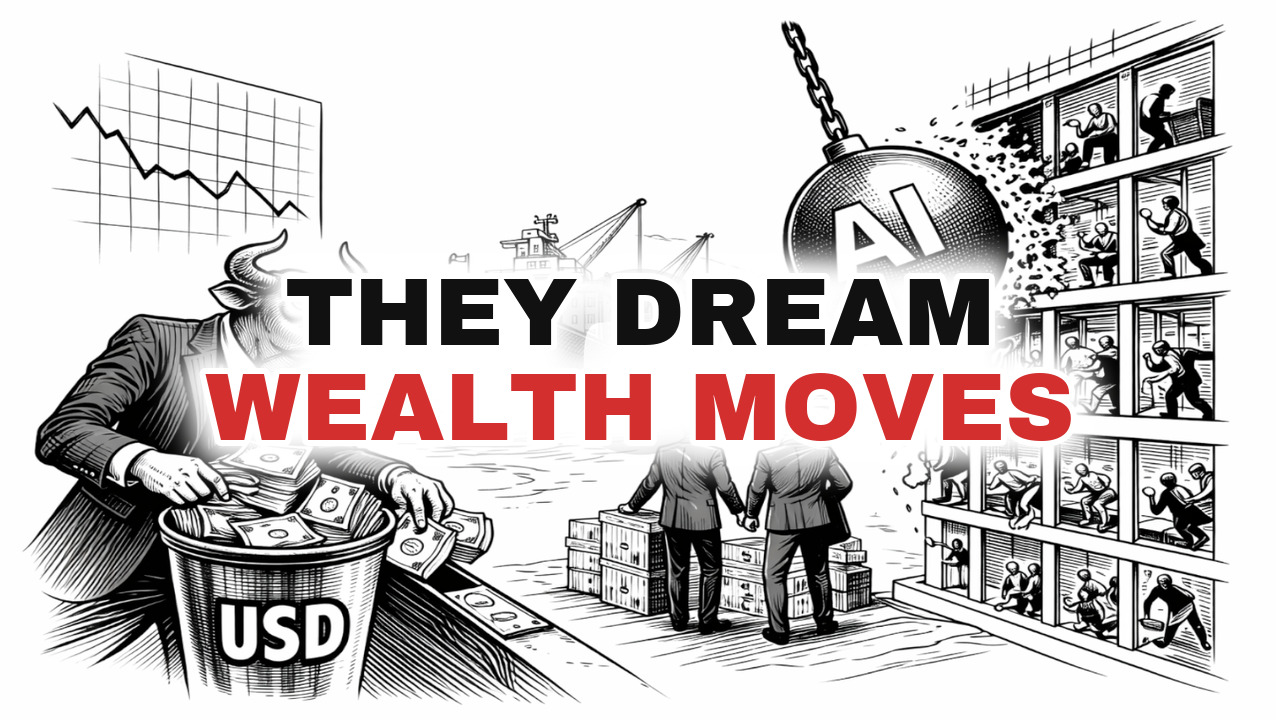
Why the dollar bears and the bond market's AI disinflation trade collide on Adobe's option chain, and what the macro calendar tests next.
What came of it
The Trade Alert on ADBE closed on 12 March 2026, after 22 days, at +40% on the capital at risk.
Panics Stacked Like Dinner Plates
Wall Street rarely settles for a single terror when it can hold several. The loudest crowd wants everyone out of the dollar and into anything listed abroad, convinced the greenback is about to fold, and skips past the structurally thin profit margins waiting in most overseas markets. Read without the megaphone, the dollar's slide looks like an ordinary drift back toward its long-run average, nudged along by foreign central banks doing the unglamorous work of managing their currency pegs.
Meanwhile the bond market is nursing an entirely different fear. Yields have been sinking while the economic data comes in hot, the opposite of what a textbook allows. The large fixed-income accounts appear to be pricing the endgame of the artificial intelligence build-out: long, structural disinflation. In their telling the technology behaves like a wrecking ball, hollowing out white-collar work and stripping companies of the power to raise prices. So the currency crowd fears a collapsing dollar while the bond crowd fears a world where nothing can be repriced upward. Both are shouting, and both cannot be right.
The Wrecking Ball Hits the Chain
Adobe sits exactly where the bond market's fear lands. Legacy software is the sector the disinflation crowd points at when it needs a victim, the business whose pricing power the wrecking ball is supposed to flatten. That is why software valuations have become the market's favorite obsession, and why a name like Adobe carries an option chain charging for drama. For anyone who trades options rather than headlines, that is the interesting part. Extreme dispersion, with the same tape printing winners and casualties side by side, means single-stock premium is where the money is being paid, by people certain about a future the bond desks and the dollar bears cannot even agree on.
The letter's answer is to stop treating a trade as a single directional bet. The Adobe structure stitches several strategies together and leans on every metric the chain offers, a way of engaging with the panic without having to know which panic wins. It also has a hard boundary: the position is built to be closed before Adobe reports, so the idea lives inside a defined window and never carries the binary risk of the print itself. Reflexive dip-buying in legacy software gets no sympathy, and the broader tape is easier to hold through equal-weight indices, where a handful of mega-caps cannot drag everything around.
Heavy Steel and Hot Prints
While the pundits argue about fiat and software multiples, the capital that actually accumulates is moving through steel and shipping lanes. New U.S. fees meant to punish Chinese-built vessels have scrambled global shipping orders, and the windfall has landed in South Korea, whose yards are filling their slipways with redirected work and locking in a bottleneck over the next decade of maritime transport. No algorithm panicked its way into that. The same quiet logic runs through tandem solar cells layering perovskite over silicon to pull far more electricity from the same footprint, and through gold and silver, where the retail mania has stalled, leveraged speculators are nursing losses, and patient players collect premium while the froth burns off sideways.
The calendar after the holiday pause is crowded. A fresh PCE report and updated GDP figures will test whether the hot-data story survives contact with the disinflation trade in bonds. Regional business surveys and housing starts add texture, and Walmart's earnings offer the least filtered reading available on the American consumer. Negotiations in Geneva could add a sudden jolt to energy markets. Then there is tax refund season, normally a reliable pipe of retail cash into speculative equities and crypto; after the drawdowns in popular tech names, whether that cash gets spent or hoarded is a live question. For Adobe specifically, the date that matters most is its own earnings release, the wall the structure has to be closed against. Everything else is noise to trade around; that date is the exit sign.
This page is the write-up. The full letter, with the trade and its exit rule, is on Substack.
- ADBE
Get the next Tuesday Target free
One options trade. Every Tuesday. Scored in public. The exit rule is on the card, and the letter is free to read.