China Large-Cap (FXI): The Summit Week the Options Overprice
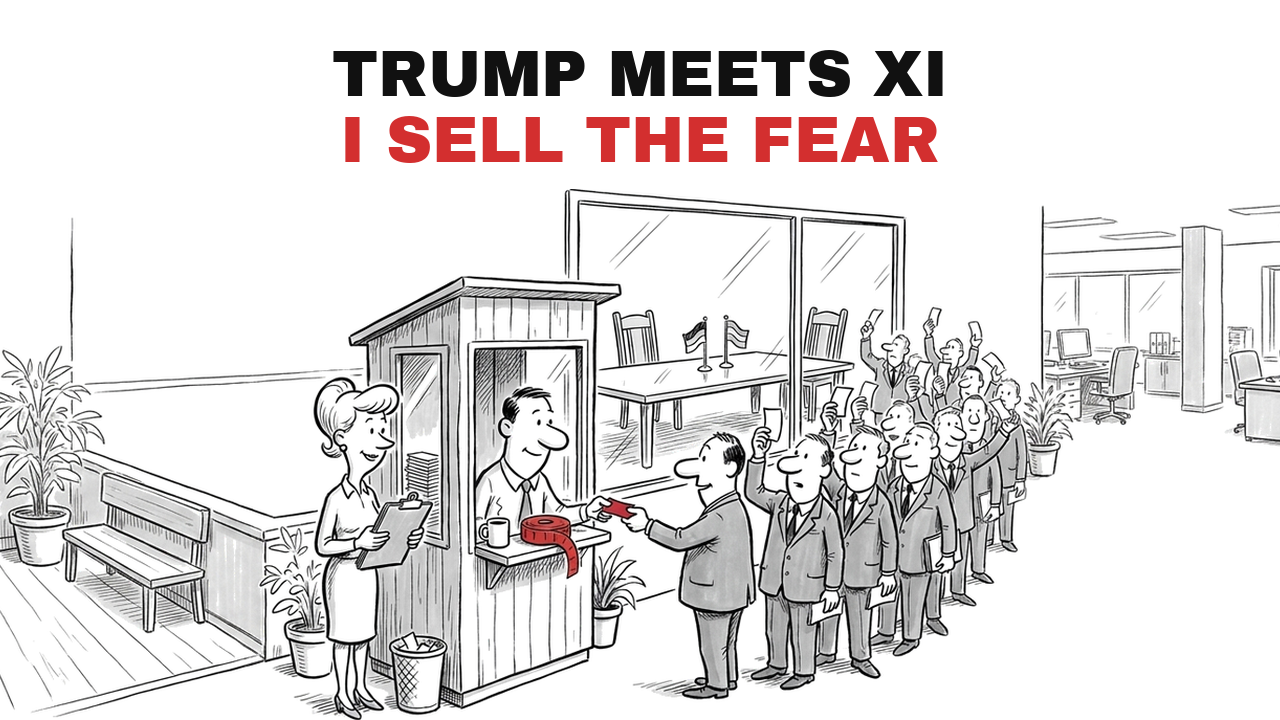
Record inflows, a Trump-Xi summit and China tech earnings in one week; why FXI's options charge more for the drama than the fund usually delivers.
Selling the Verdict Week
China spent the autumn as the trade nobody could settle. Half the desks called it the great rotation out of American tech; the other half pointed at factory prices climbing while the shopper stayed home, and called it a bounce built on state money. Mid-November stages the argument in public: Trump and Xi sit down at the Asia-Pacific summit in Shenzhen, and Alibaba, JD.com and Baidu report inside the same few days. Tencent has yet to name its date.
Money moved before the verdict. Hartnett at Bank of America puts the inflow into China at a record 86 billion dollars over a month, and credits Beijing's own state funds with much of it. FXI, the fund that holds China's largest companies, has bounced off its October low and still sits well under last year's high. Everyone wants the week to resolve something. The options price that wish: they imply a wider swing than the fund has lately delivered. The gap between what the market pays for and what the fund habitually does is the whole letter.
Both Camps Pay the Toll
The structure in the letter is an iron condor: a put and a call sold near the current price, a second pair bought further out so the worst case is fixed before the first candle prints. The credit arrives up front. It stays with me if FXI finishes the holding period inside the box, and the insurance legs cap the damage if it escapes. The position has roughly the same room above and below, which is the point. Whatever Shenzhen produces, handshake or walkout, my view is about distance traveled while the headlines argue about it.
For an options trader this inverts the usual China trade. Bulls own calls on the rotation story; bears own puts on the factory-gate inflation story. Both pay a premium shaped by their conviction, while the fund's own behavior argues for something duller: over the past year FXI stayed inside a box of this width more often than it broke out of one. When the evidence pulls in both directions, directional buyers on each side fund the person sitting in the middle. A quiet result costs them and pays me; a loud one costs me a sum settled in advance.
A Box the Market Drew Itself
The range belongs to the market's own arithmetic. The options imply a move of a given width by the exit day, and the break-evens sit about that far out on each side. On the chart the upper one rests above the long moving average, where the recent rally paused for breath; the lower one sits near the late October low. The letter treats the edges and the middle as different trades: near an edge going into the big week, I close early; parked in the center, I can afford patience past the planned exit. A loss of about half the stake, with the story changed underneath it, is the other door out.
Earnings and the summit crowd into one mid-November week, and that week carries most of the risk. Beijing is leaning toward calm: the central bank raised a currency reserve rule early in November to slow the yuan's climb, and a slower yuan means steadier dollar-priced Chinese shares, which is precisely the weather a range enjoys. After that comes the Fed on December 9, where Goldman's rates desk had a rate rise priced as the likelier outcome before the newest inflation print landed. A firmer dollar sits on Chinese equities, so the plan has me out by December 2, a week ahead of it. The summit will produce a communique and the earnings will produce adjectives. What I need from the week is for FXI to find the noise less interesting than the pundits do.
This page is the write-up. The full letter, with the trade and its exit rule, is on Substack.
- FXI
- Iron Condor
Get the next Tuesday Target free
One options trade. Every Tuesday. Scored in public. The exit rule is on the card, and the letter is free to read.